Latest Blogs
Software Development
Ramsha Khan
Jul 29, 2026
Can AI Accelerate ESG Compliance in the Logistics Industry?
Read More...

We Prefer User Experience Over Design, Here’s Why!
Generally, web designers provide an ideal graphic way to design the modern era website. They get trained and acquire the expertise of visual graphics designing. Here is the top priority that the designers manage:
Creative concept
Color theory
Typography
Icon development
Diagrams
Infographics
Interactivity rollovers
Drop-down menus
Digital slideshows
Call-to-action buttons
Forms
But, we think the user experience is far much better over designing. So, a slight discussion presents over this topic. It will provide what we prefer User Experience over Design.
User experience means, how a person feels while working together with a digital product. It contains a lot of elements among which some are manageable through the designers. The developers are involved in designing the websites which are environment-friendly or simply they fulfill user preferences. But, user experience does not mean similar to usability, but it means the experience, emotion, intuition, and connection. Further, any specific user feels when they use a website or any product.
Usability means somewhat about the efficiency of a website development and designing. It surely means how much it gets designed as user-friendly and presents significant elements that encircle entire user’s experience. So, it has developed to encompass the user-centered design and it ultimately works on the same idea presented in a different way. It really works very imperatively for any digital product(s) which means quite necessary for specific kinds of digital products. Such as complex websites, retail sales, startup websites, and low budget projects are likely to run for long periods.
User experience in terms of design means fairly essential as graphical identity and it doesn’t matter what your website looks like. Even, if people don’t recognize how to cooperate with it, they must enjoy such type of interaction. User experience means highly important for complex websites, because, the users can enable to run the website easily and know how to use it precisely. One of the best complex kind of websites can contain fairly on a retail or online sales basis.
Here, not only the websites need to manage well. But, it must also have an apparent and easy way to practice signals for how to create a safe and protected way of purchasing. It also becomes ideal for small businesses because the websites will become their first impression for the users. This first impression surely matters when it comes to leading traffic and business to your product. A similar idea also applies to businesses that it exists with low budgeting. User experience means to be of great importance because it can make certain that the momentum propels the business onward.
When we observe poor user experience, the concerns becomes highly observable. It also becomes necessary to think about the actual problems such as incapability to compare plans before making certain accounts, overloaded servers and downtime, issues in creating accounts, and facing problems in filling out applications. All such problems produce a negative passionate connection to the users of the websites. Additionally, the six vital benefits to adding user experience to the design and development practices which are: improved output, increased sales and revenue, diminished training and support costs, decreased development time and costs, decreased preservation costs and improved customer satisfaction.
Saima Naz
Oct 7, 2017

Why Should One Choose WordPress Over Wix
Choosing between WordPress and Wix is one of the most common dilemmas for anyone looking to build a website today. Wix may seem appealing on the surface with its easy setup and visual editor. Still, once you scratch beneath it, WordPress offers a level of flexibility, functionality, and control that Wix simply cannot match.
Whether it is the ability to customize your design, manage SEO, or scale your platform as your business grows, WordPress delivers on every front. As part of our web app development services, Arpatech has helped numerous businesses build powerful WordPress-powered websites that drive real results. Here is why WordPress should be your platform of choice over Wix.
Key Takeaways:
People like to use WordPress instead of Wix, as it has a self-hosted website development platform. Because it lets you pick out which domain hosting you wish to use to get your website live. One of the reasons is that it has numerous graphical depictions of hosting choices for WordPress and reasonable costs.
While Wix does not allow you to host your website from somewhere else, it means you are completely stuck with the one you are on. Suppose you find your website is running very sluggishly due to poor hosting services, or else, if you wish to move your website’s data to any other domain, you cannot do so.
WordPress makes available thousands of premade website designs that can be selected as per your needs. There also exist user-created WordPress themes to choose as your required theme, as per your business needs.
All such themes are absolutely free, while there is also a large variety of premium themes available to buy. Moreover, such WordPress themes can also be modified and adjusted according to your requirements.
When you choose to build a website using the Wix platform, you can select your templates from the 400 options available. But you cannot access the code or make any required changes to such designs or themes according to your needs, which is a great setback for Wix.
WordPress allows you to readily switch between the themes you like to change at any time. Because such themes will not affect the existing content already on your website, you can use any format adjustments as per your needs to fit better with your content, to any newly chosen theme.
One of the most limiting features of the website built with the Wix environment is that once you select any template, you cannot change or remove it ever.
A website developed using the Wix interface has a single user account and admin of the website.
While a website created on the WordPress platform allows you to create multiple accounts to modify your website, you can even assign several roles to perform after creating the necessary accounts for them. For instance, to update and add new blog posts to your website. Likely, you can create accounts and give them limited access to the writers to post or publish blog articles. They have no access to use other functions of your website that the main admin can perform.
WordPress also allows you to apply as many plugins as needed to fulfill your needs for coding and the formation of plugins that offer its users. There exists an incredible number of tools also available to modify and control their websites accordingly.
Whereas Wix does not offer any use of plug-ins, it deals in apps to support and manage the websites in its place. You can find hundreds of apps available to select and use according to your business needs. But all those are entirely developed by the Wix team and have very few apps to select from.
WordPress allows you great benefits not only to create a website, but also serves you with ideal search engine optimization (SEO) management.
It provides a great SEO friendly interface to perform multiple SEO activities for your website.
This way, you can perform good SEO practices within your website and generate more traffic to it. Using sufficient plug-ins available within WordPress can help you optimize your website. It also advances its capability to make itself visible on different search engines.
Whereas Wix offers you very limited SEO features within its boundaries. You can simply add the title and description to your generated pages, alt-text in images, and generate a sitemap.
A well-optimized WordPress website can deliver measurable business results. See how Arpatech used its web development expertise to build a streamlined fiat and crypto transactions platform and transform a complex license renewal system into a seamless digital experience.
WordPress is also considered one of the perfect platforms and ideal for blogging. It serves you efficiently for creating and publishing blog articles using its interface. Once you start using your website, you have the best option to create blog posts instinctively.
You can start creating blog articles as per your desired needs, and you can simply use it easily, just as if writing in a Word document. You can further enhance your posts by seamlessly adding different types of media, from images to videos, directly into your content with ease.
Therefore, you can manage your blog posts with extra features to set publication dates for your blogs. You have the option to assign tags and categories within the post, and have many more features using WordPress.
WordPress works better than Wix when creating websites, especially for businesses that want to grow and customize their site. If used correctly, WordPress can improve your website’s performance and help you reach more people.
At Arpatech, we help businesses transform their online presence with clean, responsive, and conversion-focused WordPress websites. Let’s build a website that works for you.
Umair Ahmed
Oct 6, 2017
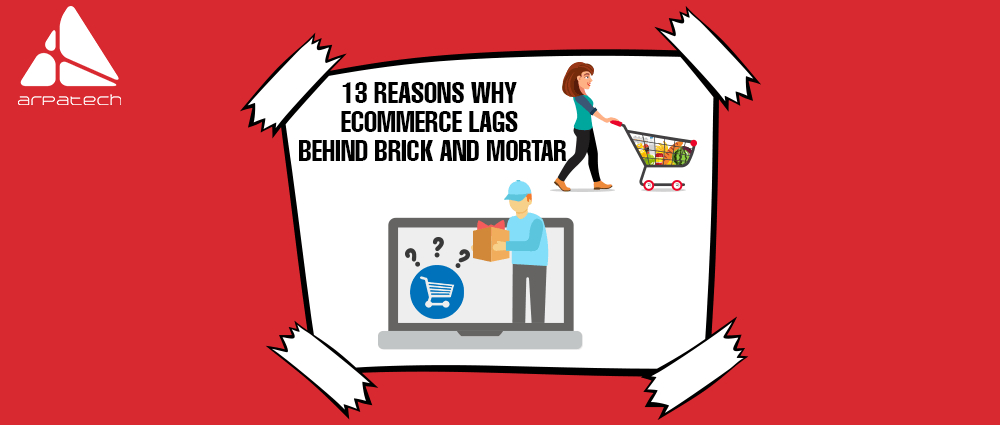
13 Reasons Why Ecommerce Lags Behind Brick And Mortar
E-Commerce has been still focusing on to boost its online physical presence prominently even after passing several years. It has been marketing and selling online products to experience the highest level of services to e-Shoppers. But now, we observe that some new businesses have started their services and are performing negative tactics to build their physical presence online. Their major motive is to boost up their products to their online customers. We all know that such tactics won’t work in this era. Because millions of online customers come to e-Commerce online shopping portals to shop faster. But, such tactics will flee the real e-Shoppers and they will never do online shopping due to their bad experience.
Here are some reasons as to why the e-Commerce industry has been lacking the physical presence across the world.
E-commerce business commonly costs not that much to run it and can easily reach their customers across the world. But, a couple of years back; we see certain reasons for going on to this route. Therefore, we need to create a specific destination to show online physical presence to get back into the business. The companies will competent enough to connect individually with the customers. It means to visit the e-Commerce sites to fulfill their needs. This could become very supportive to build stronger ties to the entire e-Commerce community. Because it supports and capable as a strong brand image among the online shoppers.
Today, new businesses get started with, just an investment of a few hundred dollars. It means a thought to make possible to open any specific online store in such amount. But, everyone can realize that in no way means that such a few hundred dollars are quite enough to invest in a store for its online physical presence. A fledgling online business must need real means of investment and an, of course, a major amount of labor is required as well.
Having the best online physical presence for your business is your well-optimized website development which should be user-friendly in all aspects. Any business plan cannot achieve without your effective website. It has everything to attract the visitors and make them certain to shop their needs. The website should get designed according to the modern e-Commerce formation. It must get fully secured, user-friendly, and entirely functional for e-Shoppers. Moreover, it should manage effective search, mobile, friendly, and need to load very fast.
Inventory management is, of course, playing a vital role in structuring a real e-Commerce platform, depending on the type of business model. Lacking such factor, it can create one of the most vital glitches for new e-Commerce businesses and will affect the operations as well. Having very little inventory on board will certainly miss out your sales. It can also create disappointment to the online customers. Even, you can ignore the freight costs, associated with getting your required inventory for your business which is also very noteworthy.
Any online e-Commerce business cannot flourish physically without having their precise product images. The specific product images mean highly significant for attracting the e-Shoppers. They may get what they are looking at your website. The ideal showcase product image will make the customers stay on the website and search for their required needs you are selling. So, make sure the product images should clearly and accurately visible in the e-Shoppers while they search for their desired products.
Any online website cannot get business without having too many visitors. The more people visit any website the more worth will be generated by the website. Having prominent flow of visitors on the website will certainly create the ideal visibility. The physical presence of your store on the search engines bring a positive sign of your business. The flow of visitors creates the real visibility and create the web traffic more to recognize in different search engines.
Online businesses have more challenges and have to face serious online competition onto the Internet. As it provides the land of opportunities for everyone, whether a large business or a new small enterprise. Hundreds of online businesses make sure they’re on the internet and competing each other in various aspects. But, no one can exist their physical presence online without surviving and facing the serious and significant competition on search engines.
Sometimes, buying something online through any e-Commerce website becomes irritated because one cannot touch and try the product physically. This leads one of the great set back to this industry because people cannot easily trust on such online shopping website, whether the purchased product will deliver at the same one saw on the shopping portal. Even, if the product delivered the right one but still there remains the chances of trying the right size that may easily fit.
While shopping at online websites; most of the e-Shoppers face different problems to get to the right industry products. Even, if they get to the exact area they find the ordering process to be very complex and irritating. The most problems created by the website’s navigation system. As some users do not get familiar with the website or its navigation system? Sometimes, the website’s navigation creates problems for the users, and sometimes; the drop-down menus, tabs, tags, footer, or breadcrumb methodologies.
One of the reasons to Frauds and scams happened while making online payments by customers. So, credit card frauds have become the major issues that are frequently observed or heard while shopping online. One cannot say whether the e-Shoppers are safe or not while purchasing something through online websites. There have been frequent complaints recorded of credit card frauds. Several e-Shoppers have become victims of fraud while making payments through using their credit cards on purchasing different products.
While online shopping; people also face great setbacks of data security concerns. It generally mentions so as to be confidential and integrity of data. There have been many cases recorded where online shoppers’ confidential data were used for unidentified objects. The threats of online users’ data by unauthorized persons are still a big problem across the world. That’s why people avoid doing online shopping for security concerns.
One thing which also creates the flaws of online shopping is that one cannot get delivered or take home the purchased products immediately basis. As one has to wait for the purchased stuff till it delivered after complete process of purchasing order. It means if anyone requires something on immediate basis cannot rely on such online shopping facility.
Online shoppers also face one of the major problems of delayed response to certain queries. While ordering online; either the system of processing orders gets hanged up or the systems figure out the queries in quite delays. Many queries remain in pending either from system’s error or for various unidentified reasons. Thus, such circumstances lead to the ineffective services that irritate the customers quite a lot.
Saima Naz
Oct 4, 2017

Customer Journey In E-commerce – Mapping The Maze
It’s not a path rather a maze! Customer journey starting from research to final purchase decision is not always frictionless. On their way, they bounce away due to poor navigation, response time delays from CSRs. Or perhaps due to unrealistic delivery charges over a product that they were willing to buy. An e-commerce seller needs to keep a track of each consumer path, and find out if it was filled with hurdles. While some issues pertaining to customer journey can be addressed in real-time, there are some that need long-term planning and a proactive approach.
Why map customer journey?
For starters customer journey mapping prepares retailers who aim to smoothen the path for an incoming customer. Furthermore, they would study the customer psychology to anticipate their shopping behavior and expectations. It’s an interesting exercise that begins by developing personas from the different types of customers interacting with the brand. For example, you can build a persona by identifying a group who actively search for coupons to make purchase decision. Some questions about the following Would enable you to build a persona:
Demographic
Psychographics
Actionable insights
The idea of building a persona is to internalize the prospects and reach out to them as real humans. Customers usually expect a personalized answer for their query.
Over 40 percent of consumers say it would be helpful if a physical store knew about their own online research conducted, prior to them purchasing (in-store)
Of course, the first stage of the consumer journey comprises of research. Today’s customer relies on numerous channels to find the relevant product. What comes after exploration?
Customer decision making
When customers reach a decision for purchase, it is never a linear path in e-commerce industry. Many times, they go back and forth between the actual trigger and finalization. Sometimes they are unclear about credit card charging procedure or perhaps faced shopping cart glitches. They may not necessarily use online platforms to interact with your brand but an ecommerce seller can map their journey by determining the following:
What’s the frequency of visits to my website?
What are the product pages this buyer is interested in?
Has the customer subscribed to the newsletter?
What was the pathway along different product pages?
Experience on e-commerce
A customer can possibly engage with your company, or visits a product page or goes through an online experience. However, in the online world, it could also be a combination of experience and engagement. The more touchpoint you have, the more complicated will be the maze but it will definitely maximize your brand reach. As an ecommerce seller, you have to work on 5 prime aspects once you have mapped the customer journey.
In the process, the highest value customer journeys’ are noted, their shopping pattern and behavior is studied. This enables ecommerce sellers to create valuable experiences for similar customers.
Let’s delve into some tips from the pros in ecommerce
Saima Naz
Oct 4, 2017

7 Hacks To Boost Your e-Commerce ROI
The advancement of e-Commerce hacks is all about to get the advantage. It works for elimination to achieve the maximum traffic, revenue or even signups. Scaling and structuring have not been that much so simpler. One can struggle for few hours on a specific campaign. This can carry out on daily, weekly or monthly basis unless any action of interfering.
Given below presents seven Boosting hacks for e-Commerce ROI (Return on Investment):
Content plays a prominent part in attracting visitors and the best way to market brands or claims. It surely has a solid base in creating the impression of the product to describe it as per needs of customers. Seventy percent of consumers desire to get to know a company through described content rather than an ad. It is also very significant to note that one has few seconds to get customer’s attraction before they move on. So, the striking content needs to be easy and impressive to engage the audiences.
Contact here for Digital Marketing Assistance
Images also perform is effective support in attracting the customers and increasing sales and revenue of the company. Images help grow business goals and achievements effectively and support in selling the specific product to the right customer. It is really significant to use images that represent the product features and will create the entire focus on the needs of customers.
Using the strategy of emailing to the targeted customers is also one of the successful marketing skills. So, it creates a positive sense to use the support of email campaign as one of the excellent e-Commerce growth hacks. An email that includes complete product details is a great way to let the customers know about the new information that will follow them to think about their needs.
Boosting any business by using the video marketing skills is also one of the fastest means of flourishing the business. It is one of the attractive and striking means of advertising company products. A minute of video can easily represent the intention of a product well to the customers. Today, using the video market is the ideal way to use this growth hack to increase business revenue or ROI.
People are really concerned about Return and Refund when they shop products online. So, to overcome this major concern from the customers; set a prominent policy by highlighting the returns and refunds to attract the customers to clear any ambiguity that exists in their minds. This policy can also provide the best opportunity to convert more and more customers as returning and refunding will generate positive thinking and will eliminate the option of ambiguity.
For boosting ROI of any e-Commerce business, social proof generates reliability and impression on customers. It implies that specific online store is trusted by a large community and influencers, and it’s not just overvalued up by clever descriptions. Social proof is also thought to be useful for tapping into customer psychology because the customers get a cue when they see the experiences of other people. Social proof can be in different forms like online reviews, ratings, and number of people bought such products etc.
Re-marketing is the fundamental approach as positive hacks to boost return on investment (ROI). It is generally the process of pursuing website visitors and then aiming them with proper content after they leave. This goal is simply to re-engage the customers and a try to bring them back to shop again. Re-marketing provides the best opportunity to transform bounced visitors, improve ROI budgets, increase brand awareness, increase visitors and site engagement.
Saima Naz
Oct 1, 2017


Before we begin, please solve this quick math check to confirm you're human, and you'll be all set to start chatting with our AI assistant.
Stay connected with us to receive the latest information, updates, and insights from our world of innovation.
By entering your email address you will receive promotional updates.


© 2026 ARPATECH (ADVANCED RESEARCH PROJECTS & TECHNOLOGY)