As businesses deal with economic challenges, shortages of skilled workers, and rapid technological changes, IT outsourcing has grown into an essential business strategy rather than just a tool for reducing expenses. Whether you’re a startup looking to expand or a large organization managing intricate systems, understanding how IT staff augmentation services are priced is one of the most important decisions you’ll make before signing any vendor agreement.
Get it wrong, and you end up overpaying for underperformance, or locking yourself into a model that doesn’t fit how your project actually works.
But if you get it right, you access world-class talent, predictable costs, and faster delivery.
In this blog, we’ll cover:
IT outsourcing revolves around assigning IT functions and responsibilities to a third-party service provider, such as software development, infrastructure management, cybersecurity, help desk support, and cloud services, to an external service provider. Rather than maintaining an entirely in-house team, organizations partner with IT outsourcing companies to access specialized skills, reduce overhead, and improve operational efficiency.
According to Statista, the global IT outsourcing market is projected to reach $812 billion by 2029, driven by the growing demand for cloud infrastructure, cybersecurity, and specialized development talent across every major industry.
IT outsourcing is no longer something only large enterprises do. Startups, mid-sized businesses, and even solo founders are using it to do more than their size would normally allow, accessing talent and infrastructure that would otherwise be completely out of reach. The model has matured significantly, and in 2026, the question is no longer whether to outsource, but how to do it in a way that genuinely drives results for your business.
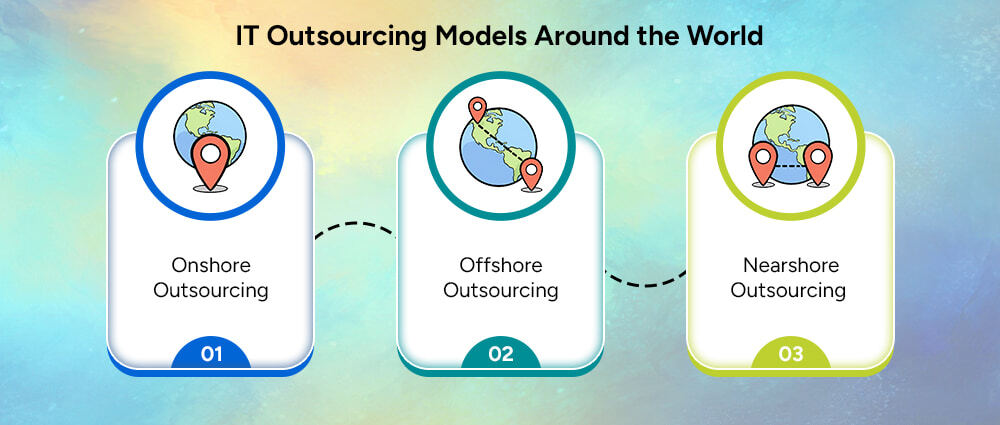
Before selecting a pricing model, it’s important to understand the three primary engagement models based on geography, because where your provider is located directly shapes what you pay and how smoothly the collaboration runs.
Domestic outsourcing means working with a service provider located within your own country. It offers seamless communication and cultural alignment, but comes at the highest cost. For businesses where compliance, data residency, or real-time collaboration are non-negotiable, onshore IT outsourcing is often worth the premium.
By working with providers in countries like India or the Philippines, offshore outsourcing enables businesses to significantly cut costs, with savings often falling between 50% and 70% lower than local rates. The tradeoff is managing time zone differences, language barriers, and occasional cultural gaps that can slow things down if not handled proactively. See how distributed execution was managed effectively in Arpatech’s OT systems on edge nodes engagement, where offshore collaboration was central to delivery.
Nearshore IT outsourcing provides a balanced solution by partnering with firms in neighboring countries. Cost savings typically range from 30% to 50% compared to domestic rates, and with overlapping time zones and a closer cultural fit, it tends to work particularly well for agile development teams that need daily touchpoints and fast feedback loops.
Choosing the right pricing model matters just as much as finding the right outsourcing partner. Here are the most commonly used models in 2026
The fixed price model establishes a mutually agreed-upon cost between the client and the provider for a specific set of deliverables. The entire project cost is established up front, and you know exactly what you will pay, before a single line of code is written. The total price depends on project scope but typically ranges from $10,000 for small projects to $500,000+ for large implementations, with payment usually structured in milestones.
This model is most effective for projects with a well-defined scope and requirements that are unlikely to change. However, any changes to the agreed scope will typically result in additional costs through change orders.
The time and materials model means you pay for the actual hours worked and resources consumed, with the provider billing you on a regular basis, usually monthly. While this model offers great flexibility and is ideal for projects where requirements are likely to evolve, it does place more financial responsibility on the client since costs can shift with scope changes and project complexity. It pairs well with agile delivery, where sprints are planned iteratively rather than defined all at once.
The dedicated team model was initially designed for long-term collaboration, but recent trends show it can also help organizations scale efficiently while keeping IT outsourcing costs manageable. You get a fully integrated remote team that works exclusively on your product: developers, QA engineers, designers, and project leads, operating as a seamless extension of your internal workforce. It’s best suited for ongoing product development or businesses that need consistent, high-output delivery over an extended period. Take a look at how this played out in Arpatech’s digital twin management case study, where a dedicated team structure was key to hitting complex technical milestones.
Built on a subscription-based structure, the managed services model delivers ongoing IT support with consistent and predictable pricing. A provider takes complete ownership of defined IT functions, like network security, cloud infrastructure, or help desk operations, billing a flat monthly fee while staying focused on prevention and optimization rather than simply addressing issues after they occur. This is one of the most popular models for businesses that want to hand off operational IT entirely and focus internal energy on growth. Explore how Arpatech’s IT help desk support services keep businesses running without the overhead of an in-house IT department.
For small and medium businesses that need dependable IT support without the complexity of negotiating custom contracts, per-user pricing keeps costs clear and manageable. Rates typically fall between $100 and $250 per user per month, with very few hidden fees. It scales naturally as your team grows, making it a practical starting point for businesses that are still figuring out their long-term IT needs.
Newer IT outsourcing pricing structures like gain-sharing agreements, results-based contracts, and shared risk-reward arrangements are becoming more common in 2026. These models bring vendors and clients closer together by tying compensation directly to outcomes, encouraging genuine collaboration and mutual accountability rather than just billing for hours. For businesses undertaking high-stakes digital transformation, this model can be a powerful alignment tool.
Several variables determine how much IT outsourcing will cost your organization:
Geography is the single biggest factor in IT outsourcing costs. The same developer role costs dramatically different amounts across regions due to labor markets, cost of living, currency exchange rates, and local competition. Eastern Europe and Southeast Asia consistently offer strong value without compromising on technical quality.
Labor accounts for the largest share of IT service outsourcing costs. The level of expertise, size of the team, and location directly impact rates. Senior architects and security specialists will always cost more, while mid-level developers in cost-competitive regions can deliver exceptional output at a much lower cost than hiring locally.
Licensing fees, cloud infrastructure, development tools, and security platforms are cost drivers that quietly but consistently influence IT outsourcing pricing over time. Always make clear from the beginning which tools are included in the engagement and which you’ll need to manage outside the agreement.
Compliance standards like GDPR, SOC 2, and HIPAA push outsourcing vendors to follow strict processes and secure DevOps practices. These added layers of oversight directly influence offshore software development costs, as they demand specialized talent and purpose-built tooling. For businesses in regulated industries: healthcare, fintech, legal, this is a non-negotiable line item. See how compliance-driven delivery was handled in Arpatech’s environmental management organization case study.
When continuous support is part of the agreement, recurring costs tend to rise. This directly affects managed IT services pricing for both small businesses watching their budgets and enterprises managing large-scale IT planning. Be specific about SLAs and response time expectations before contracts are signed.
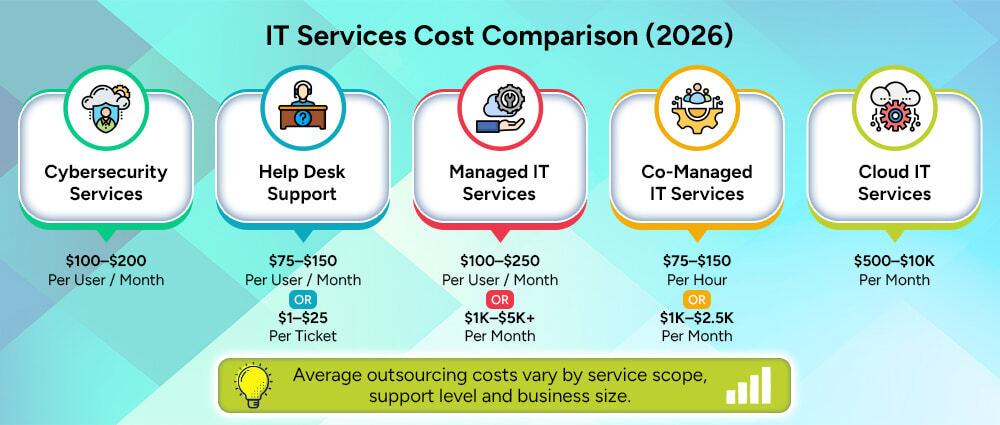
Understanding what different IT services outsourcing categories actually cost helps you budget more accurately and avoid surprises mid-engagement.
There is more to IT outsourcing than just saving money. IT outsourcing in 2026 is really about making smart, informed decisions that line up with your business goals, risk appetite, and growth ambitions. Organizations that take the time to understand their pricing options, choose the right engagement model, and work with a trusted IT outsourcing company are far better positioned to drive value while keeping their operations secure and efficient.
Whether you’re exploring IT outsourcing services for the first time or renegotiating an existing vendor relationship, the right model, matched to the right partner, makes all the difference. Get in touch with a specialist and let’s figure out what works best for where you want to take your business.
IT outsourcing costs differ based on the scope of services, industry, and location of your provider. Generally, costs range from $80 to $500 per user per month, with some comprehensive solutions exceeding $1,000 per user.
Basic help desk support will naturally cost less than full infrastructure management or cybersecurity services, and providers in Eastern Europe or Southeast Asia will be more cost-effective than those in North America or Western Europe. The best way to get accurate figures is to outline your requirements and request proposals from multiple vendors.

Before we begin, please solve this quick math check to confirm you're human, and you'll be all set to start chatting with our AI assistant.
Stay connected with us to receive the latest information, updates, and insights from our world of innovation.
By entering your email address you will receive promotional updates.


© 2026 ARPATECH (ADVANCED RESEARCH PROJECTS & TECHNOLOGY)